---
description: "Plan and Solve involves the use of an improved zero-shot CoT prompt. This generates more robust reasoning processes than standard Zero-Shot CoT on multiple reasoning datasets"
---
Plan and Solve1 improves the use of an improved Zero-Shot Chain Of Thought (CoT) prompt which adds more detailed instructions to the prompt given to these large language models.
!!! example "Plan and Solve Prompt"
[User Prompt]
**Let’s first understand the problem, extract relevant variables and their corresponding numerals, and make a complete plan.Then, let’s carry out the plan, calculate intermediate variables (pay attention to correct numerical calculation and commonsense), solve the problem step by step, and show the answer.**
[Model Response]
**Therefore the answer(arabic numerals) is**
This is a two step process which guides the LLM to pay more attention to calculation and intermediate results to ensure that they are correctly performed as much as possible.
1. **Generate Reasoning**: In the first step we prompt the model with the user's query and prime the model using plan and solve prompting to explicitly devise a plan for solving a problem before generating an intermediate reasoning process
2. **Extract Answer** : Once we've obtained the model's reasoning, we then extract the answer from a new prompt which includes the model's chain of thought.
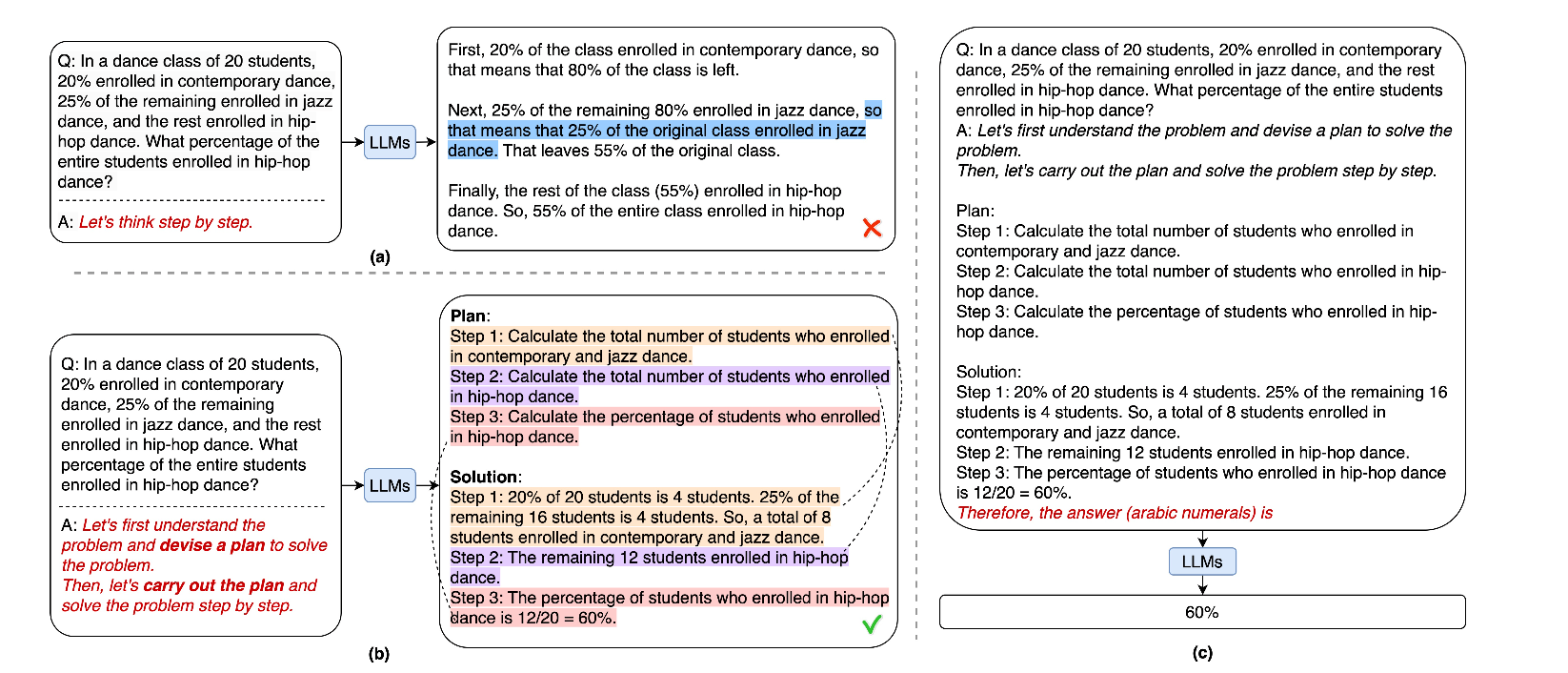
We can implement this using `instructor` as seen below.
```python hl_lines="26-34 67"
import instructor
from pydantic import BaseModel
client = instructor.from_provider("openai/gpt-5-nano")
class Reasoning(BaseModel):
chain_of_thought: str
class Response(BaseModel):
correct_answer: str
def generate_reasoning(query: str):
return client.create(
messages=[
{
"role": "user",
"content": f"""
{query}
Let's first understand the problem,
extract relevant variables and their
corresponding numerals, and make a
complete plan. Then, let's carry out
the plan, calculate intermediate
variables (pay attention to correct
numerical calculation and commonsense),
solve the problem step by step, and
show the answer.
""",
},
],
response_model=Reasoning,
model="gpt-4o",
)
def extract_answer(query: str, reasoning: Reasoning):
return client.create(
messages=[
{
"role": "user",
"content": f"""
{query}
Let's first understand the problem,
extract relevant variables and their
corresponding numerals, and make a
complete plan. Then, let's carry out
the plan, calculate intermediate
variables (pay attention to correct
numerical calculation and commonsense),
solve the problem step by step, and
show the answer.
{reasoning.chain_of_thought}
Therefore the answer (arabic numerals) is
""",
}
],
model="gpt-4o",
response_model=Response,
)
if __name__ == "__main__":
query = (
"In a dance class of 20 students, 20% enrolled "
"in contemporary dance, 25% of the remaining "
"enrolled in jazz dance and the rest enrolled "
"in hip-hop dance. What percentage of the entire "
"students enrolled in hip-hop dance?"
)
reasoning = generate_reasoning(query)
print(reasoning.model_dump_json(indent=2))
"""
{
"chain_of_thought": "Let's first break down the
problem:\n\n1. Total number of students = 20\n2.
Percentage enrolled in contemporary dance = 20%\n\n
Step-by-Step Plan:\n1. Calculate the number of
students enrolled in contemporary dance.\n2.
Calculate the remaining students after contemporary
dance enrollment.\n3. Calculate the percentage and
number of students from the remaining who enrolled in
jazz dance.\n4. Determine the remaining students who
enrolled in hip-hop dance.\n5. Finally, calculate the
percentage of the entire students who enrolled in
hip-hop dance.\n\nLet's carry out the plan:\n\n1.
Number of students enrolled in contemporary dance =
20% of 20 = (20/100) * 20 = 4\n2. Remaining students
after contemporary = 20 - 4 = 16\n3. Percentage of
remaining students enrolled in jazz dance = 25%\n
Number of students enrolled in jazz dance = 25% of 16
= (25/100) * 16 = 4\n4. Remaining students after
contemporary and jazz = 16 - 4 = 12\n5. The number of
students enrolled in hip-hop dance = 12\n6.
Percentage of entire students enrolled in hip-hop =
(Number of hip-hop students / Total students) *
100\n Percentage = (12 / 20) * 100 = 60%\n\nThus,
60% of the entire students enrolled in hip-hop dance."
}
"""
response = extract_answer(query, reasoning)
print(response.model_dump_json(indent=2))
"""
{
"correct_answer": "60"
}
"""
```
### References
1: [Plan-and-Solve Prompting: Improving Zero-Shot Chain-of-Thought Reasoning by Large Language Models](https://arxiv.org/pdf/2305.04091)