---
description: "Faithful Chain of Thought aims to use multiple reasoning steps to improve the quality of the final outputs"
---
Faithful Chain of Thought1 improves the faithfulness of reasoning chains generated by Language Models by breaking it up into two stages
1. **Translation** : We first translate a user query into a series of reasoning steps. These are a task specific set of steps that we can execute deterministically.
2. **Problem Solving**: We execute our steps and arrive at a final answer that we can derive. This ensures that our Chain Of Thought is able to derive a answer that is consistent with the reasoning steps.
They list a few examples in the paper of what these task-specific steps could be
1. **Math Word Problems** : Python Code that can be executed by an interpreter to derive a final answer
2. **Multi-Hop QA** : This is a multi-step reasoning process. To solve this, they use a mix of python and Datalog ( which is a relation and log programming language ) to arrive at a final answer
3. **Planning** : When trying to generate a plan to solve a user query, they generate a list of symbolic goals in a Programming Language and then call a PDDL Planner to obtain a plan to solve the user's query
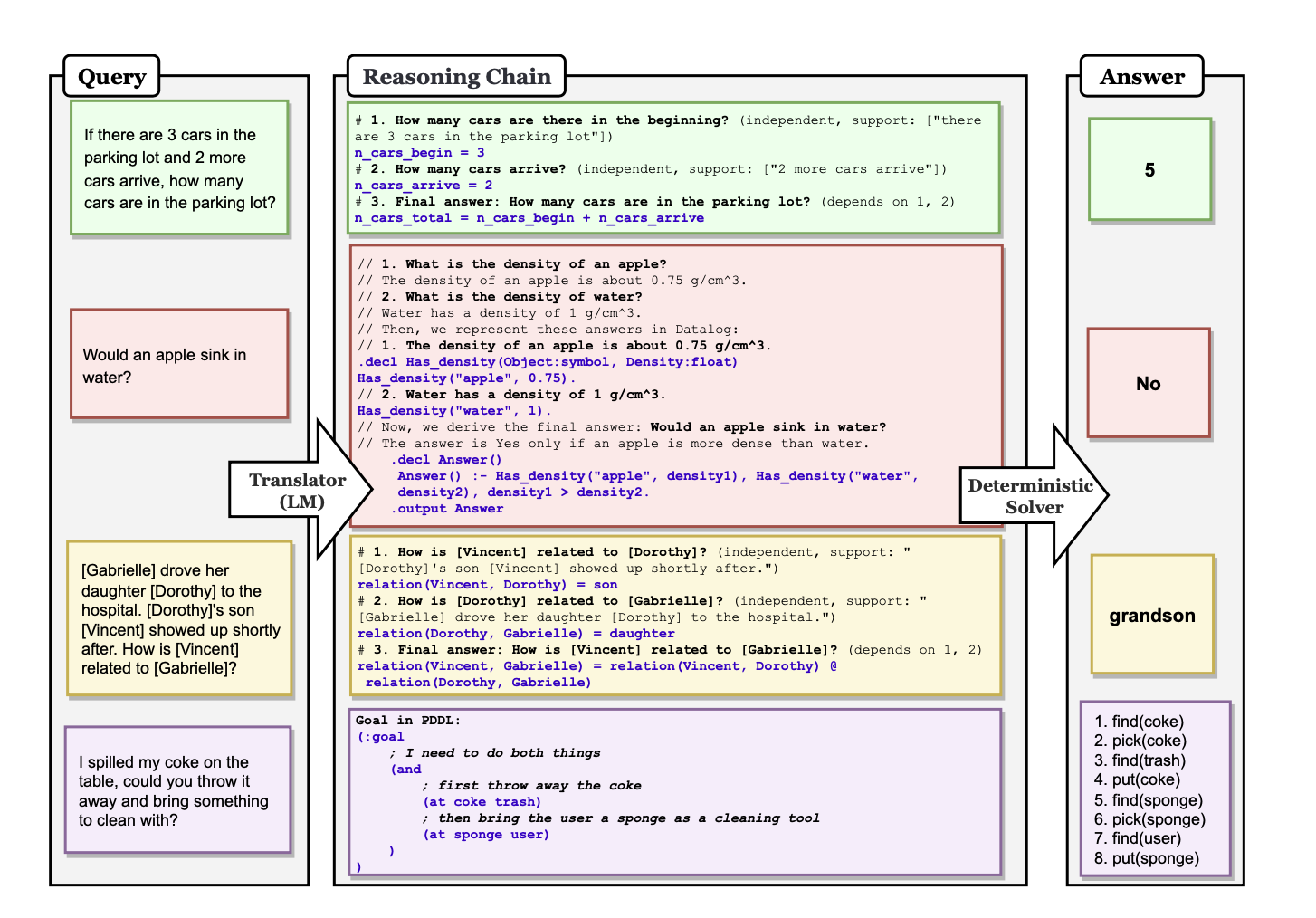
In the example below, we show how you can use a LLM to generate python code that can be executed by an Interpreter to arrive at a final answer.
We can implement it in `instructor` as seen below
```python hl_lines="30-45"
import instructor
from pydantic import BaseModel, Field
client = instructor.from_provider("openai/gpt-5-nano")
class ReasoningStep(BaseModel):
id: int = Field(description="Unique ID")
rationale: list[str] = Field(
description="""Specific sections from prior reasoning
steps or the context that ground this reasoning step"""
)
dependencies: list[int] = Field(
description="""IDs of prior reasoning steps that this
reasoning step depends on"""
)
eval_string: str = Field(
description="""Python Code to execute to generate the
final evaluation"""
)
def generate_reasoning_steps(query: str) -> list[ReasoningStep]:
return client.create(
messages=[
{
"role": "system",
"content": """
You are a world class AI who excels at
generating reasoning steps to answer a
question. You will be given a question
and you will generate a list of reasoning
steps that are needed to answer the
question.
At each point you should either
- declare a variable to be referenced
later on
- combine multiple variables together to
generate a new result that you should
store in another variable
The final answer should be stored in a
variable called `answer`.
""",
},
{"role": "user", "content": query},
],
model="gpt-4o",
response_model=list[ReasoningStep],
)
if __name__ == "__main__":
steps = generate_reasoning_steps(
"""If there are 3 cars in the parking lot and 2 more
cars arrive, how many cars are in the parking lot
after another 2 more arrive?"""
)
code = "\n".join([step.eval_string for step in steps])
print(code)
"""
initial_cars = 3
arriving_cars = 2
cars_after_first_arrival = initial_cars + arriving_cars
final_car_count = cars_after_first_arrival + 2
answer = final_car_count
"""
exec(code)
local_vars = {}
exec(code, {}, local_vars)
print(local_vars.get("answer"))
#> 7
```
### References
1: [Faithful Chain-of-Thought Reasoning](https://arxiv.org/pdf/2301.13379)